Thursday, 16 May 2024
Menu




Take a look at the photos from the first day of the conference: Gallery from the first day of the conference.
Baltictech 2011 – report day 1
15:00 Rick Staton – The latest Pozo Azul projects – Spain
 The substantive part of the conference closes with Rick Staton’s talk on the exploration of Spain’s Pozo Azul cave. The cave is not fully flooded, so researchers alternated between exploring some of the chambers underwater and others on the surface. In total, they managed to penetrate 3.5km into its depths. Penetration of the cave has been carried out since the 1970s.
As an Epilogue to this year’s meeting, an excursion combined with a visit to a hyperbaric chamber at the Institute of Hyperbaria and Tropical Medicine in Gdynia remained for all those willing to participate.
14:00
 Dr. Hac from the Maritime Institute in Gdańsk was the penultimate speaker at this year’s Baltictech. One of the best informed people about wrecks on the bottom of the Baltic Sea, he prepared a presentation on hazards and pollution near sunken ships.
An experienced researcher, he discussed with the audience the purpose, methods and results of research conducted on behalf of the Maritime Institute in Gdańsk. He made the audience aware of the threats posed by wrecks to the environment and their possible consequences.
Simultaneously, in the second room, Wojciech Jechna and Dimitris Stavrakakis, talked about their experiences with PFO. Their presentation included the background of the procedure, its course and their own impressions. There was also an opportunity to ask questions to everyone who is concerned, curious or curious about PFO.
13:00 J P Imbert – Deep diving for practitioners and dreamers
 Today’s presentation by JP Imbert, was about the history and development of deep diving. During the hour-long lecture we went back to the very beginning of deep diving, following successive attempts in countries such as Norway, Switzerland and Brazil.
The subsequent attempts, development and improvement of equipment, the creation of new solutions and gas mixtures, and hundreds of hours of research and experimentation to be able to dive deeper and deeper. JP has done an excellent job of compiling an almost cross-sectional encyclopaedia of this field of diving, with many photos of divers, equipment, the entire infrastructure and diagrams of the equipment used in subsequent years.
The whole was summed up by a section on technical diving as we know it today and the pioneers of such and their development. JP Imbert also analysed the many projects he was involved in, which were very interesting because of their pioneering achievements and the first results of research into how the human body behaves when crossing barriers.
 In the workshop room, Krzysztof Wnorowski and Tomasz Stachura, talked about the use of electricity underwater. The technological progress that has been made in this field has raised many questions, which the speakers decided to answer. They presented their opinion on the benefits that can be achieved in different types of diving, using the latest equipment based on electricity.
12:00 Nick Toussaint – Planning long rebreather dives
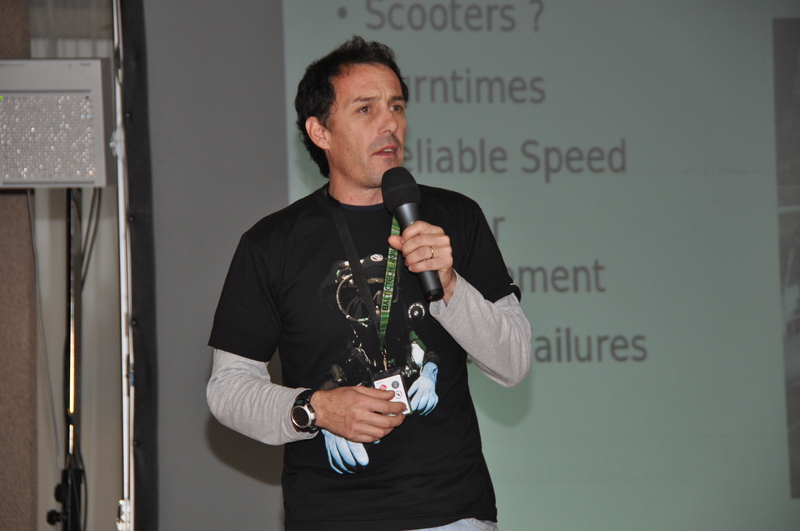 In his introduction, Nikck touched on the number of accidents in technical diving, which has doubled in the last year, and explained the purpose of the presentation he had prepared, noting that it was his personal viewpoint on safety.
The next item was an introduction to long range exploration in cave diving. He discussed in detail the risks faced by those who choose to do this type of diving. Nick stressed the importance of being in the right physical and mental condition. Stamina, concentration and the right lifestyle are key according to him, but the disposition of the day also has an impact. It’s important to be able to objectively assess your capabilities and disposition.
He then devoted a lot of space to dive planning, which can sometimes take several weeks or even months. According to Nick, we should always assume the worst case scenario in terms of the gases we use, as there are many situations where we will have to e.g. share the gas, start using more, or simply lose it in some other way. Proper prevention against limits will minimise the risk.
In the last part of his lecture, he focused on the logistics of diving and transporting our equipment underwater using a scooter and how to deal with its failures. He also did not ignore the aspect of proper dive protection, in terms of informing the right people, checking the rescue structure in the area and the possibility of its use.
11:00 am
 Phill Short, Baltictech’s second guest, started his lecture with an introduction to rebreather characteristics, their use and training. Then, he divided closed circuits into those dedicated to technical and recreational diving.
He first classified what we consider to be technical diving, then detailed the basic risks a technical diver faces.
After an initial analysis of technical diving, he moved on to closed circuits for recreational divers. As with technical diving, he characterised this type of diving and divers considered recreational. He explained the differences in training and the training programme, and then moved on to the dangers to which a sports diver using a rebreather is exposed, resulting mainly from insufficient training.
The next part of the lecture dealt with ways of reducing the risks associated with the use of closed circuits. He emphasised the advantage of a display placed in front of the diver’s mask in limiting the possibility of oxygen poisoning and presented interesting solutions that this option allows.
Finally, Phill presented assumptions and goals for the near future in the realm of rebreathers.
10:00 Hallvard Opheim – Recent projects – dives on Blücher and Elisabeth Bornhofen
 A very interesting presentation of two diving projects was given by Hallvard Opheim, invited from Norway. Dives on the wrecks of Elizabeth Bornhofen and Blucher, described by him, made a very big impression on the audience. In both cases, the perfectly sketched historical outline, supported by archival materials, very well built the atmosphere and imagination of the listeners about the sunken vessels and the circumstances of their sinking.
The next stage in both cases was a fairly detailed presentation of the logistics of the dives, the equipment used and a description of the difficulties faced by the divers. The very factual information allowed us to feel very much in the shoes of the participants of both projects.
Phenomenal photo and video materials were shot for both wrecks, which, edited in a very skilful way, transported the participants of the lecture to the bottom of Norwegian fjords, allowing them to enjoy the view of the majestic wrecks and the surrounding fauna and flora.